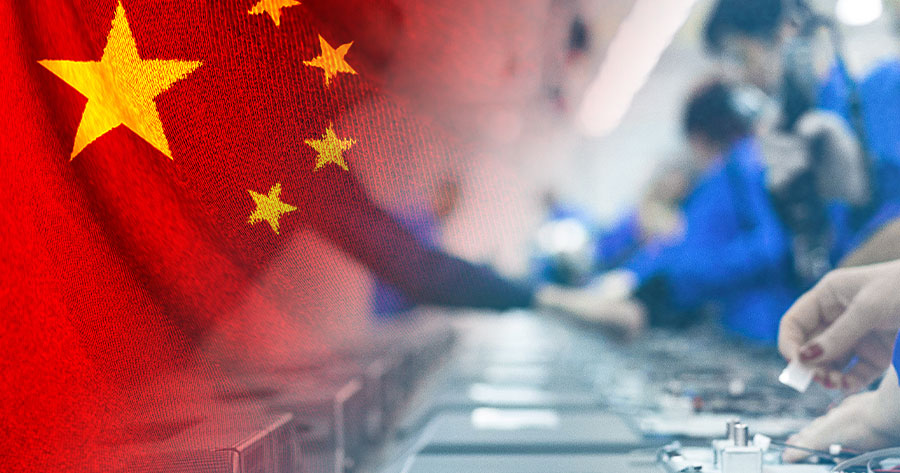
Chinese manufacturing activity recorded its strongest growth in a year during March, as the country’s official Purchasing Managers’ Index (PMI) climbed to 50.4, according to data released by the National Bureau of Statistics.
The result surpassed analyst expectations, which were set at 50.1, and marked a turnaround after PMI readings below 50 earlier in the year. March’s reading compares with 49.3 in January, 49.0 in February, and 50.5 in March of the previous year.
Breaking down the official PMI, both output and new orders returned to expansion territory, with figures above 51 in March. New export orders also improved, moving up to 49.1 from 45 in the previous month, although they remained below the expansion threshold. By contrast, sub-indexes tracking employment, raw materials inventories, and delivery times continued in contraction.
The upturn was boosted by factories resuming production rapidly following a lengthy national holiday in mid-February, according to NBS chief statistician Huo Lihui, who also noted broad-based improvement among large and small manufacturers.
Service sector momentum also picked up. The official non-manufacturing PMI, which reflects performance in industries like tourism and construction, climbed to 50.1 in March from 49.5 in February.
Chinese exports jumped 21.8% year-on-year in the first two months of 2026, substantially outpacing forecasts on the strength of demand from Southeast Asia and Europe, offsetting ongoing weakness in shipments to the United States. Last year, China marked a record $1.2 trillion trade surplus, buoyed by robust electronics exports, notably semiconductors.
Despite the recent recovery in factory activity, persistent risks have emerged due to the Middle East conflict, which has increased transport costs and import prices for key commodities such as crude oil and chemicals.
This environment is evident in the PMI’s input price sub-index, which rose sharply to 63.9 in March, while the gauge for factory-gate prices climbed to 55.4. These cost pressures, according to industry officials and the China Association of Automobile Manufacturers, could impact sectors such as automobile exports, with the Middle East accounting for roughly 20% of China’s vehicle exports in the previous year.
Some expect the impact of supply chain disruption and price inflation to persist until U.S. President Donald Trump’s planned visit to China in May, when he is set to meet with President Xi Jinping, as noted by Cameron Johnson of consulting firm Tidalwave Solution. Factory managers are preparing to manage potential challenges over the next few weeks.
Rising costs may also squeeze margins for manufacturers, placing pressure on employment and domestic demand. Chinese policymakers have reiterated their commitment to shifting economic reliance toward internal consumption, though structural reforms are expected to take time as external uncertainties continue.
Notably, a separate PMI compiled by RatingDog and S&P Global will be released on Wednesday and is expected to edge lower, with a projected reading of 51.6 in March, following February’s five-year high of 52.1.